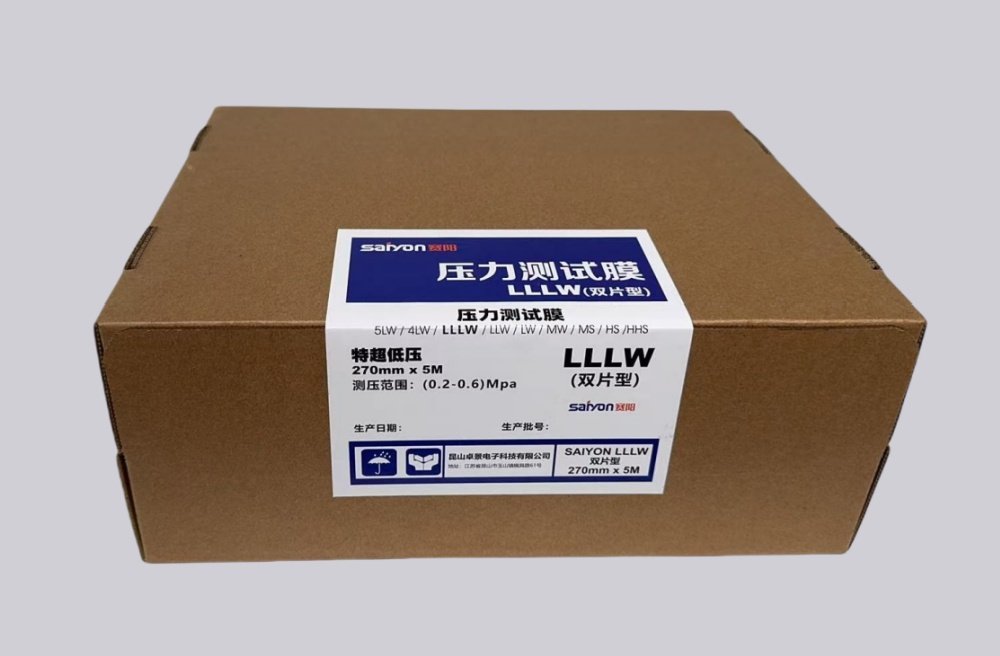


When users search for Fuji Prescale LLLW, they are often already familiar with the general purpose of pressure measurement film. What they usually want at this stage is not a basic definition, but a clearer understanding of the pressure range, application logic, and whether another film option can serve the same testing purpose.
This makes the keyword commercially relevant, but the real value of the page should still come from technical clarity. In industrial use, pressure film is selected for a job, not for a name alone. If the testing task involves ultra-low pressure contact evaluation, then the key question becomes whether the film range, structure, and result readability are appropriate for that task.
What LLLW Is Used for in Practice
LLLW is generally associated with ultra-low pressure measurement. In this range, the objective is to reveal pressure distribution under relatively light contact conditions. The film is used when a visible pressure map is more useful than a simple force value.
This matters because many contact problems are not obvious at the assembly level. A part may appear fully seated, but actual pressure can still be uneven. A sealing interface may look closed, but contact may still be weak in some zones. A soft surface may compress under load, yet the pressure pattern may remain non-uniform.
For this kind of work, ultra-low pressure film is useful because it makes contact behavior visible. Instead of relying only on load settings or visual assembly judgment, the user can see where the contact is stronger, weaker, or missing.
Why Users Look Beyond a Single Product Name
In real testing work, users often begin with a known product name because that is what they have seen in drawings, purchasing records, or earlier reports. But once the actual selection process starts, the focus usually becomes broader.
They may need to confirm whether the same pressure range can be sourced more easily. They may want to compare different supply options. They may also need to determine whether another pressure measurement film can be used without changing the logic of the test.
That is why a selection guide matters. The purpose is not to reduce the decision to branding, but to identify what really determines whether a film is suitable for ultra-low pressure measurement.
What Makes an Equivalent Pressure Film Relevant
An equivalent pressure measurement film is relevant when it can support the same type of application under the same practical testing logic.
The most important factor is pressure range. If the target contact pressure is within the same ultra-low band, the film is at least technically relevant. If the range does not match, the rest of the comparison becomes much less meaningful.
The second factor is film structure. In this category, many products follow a two-sheet format that produces a visible image when pressure is applied. If the alternative uses a comparable structure, the testing method is easier to align.
The third factor is the quality of the developed image. A usable film must produce a result that is readable enough for engineering judgment. If the image is weak, unstable, or difficult to interpret, then the film may not be suitable for routine testing even if the nominal range looks close.
The fourth factor is handling behavior. Ultra-low pressure films are sensitive materials. Storage condition, contamination, surface cleanliness, and operator handling can affect the developed result. A practical equivalent must remain usable under real working conditions, not only under ideal specification assumptions.
Key Selection Points for Ultra-Low Pressure Film
A more useful way to select film is to start from the application itself.
First, define the actual pressure condition that needs to be measured. Many users know they need a low-range film, but the exact target pressure still needs to be clarified before choosing a product.
Second, consider the test purpose. Some tasks need only a visible contact check, while others require a more detailed interpretation of pressure distribution. The required level of clarity affects what kind of film performance is acceptable.
Third, review film size and supply format. In real work, width and roll length affect how the film can be cut, placed, and repeated across multiple samples. A technically suitable film may still be inconvenient if the format does not match the test setup.
Fourth, check handling and storage requirements. This is especially important in ultra-low pressure work, where material condition can influence result quality more easily than in higher-pressure testing.
When Equivalent Options Are Practical
Equivalent pressure measurement film options are often suitable for internal engineering evaluation, process checks, incoming inspection, maintenance testing, and development-stage verification.
In these applications, the main question is usually practical: can the film show the contact state clearly enough for decision-making? If the answer is yes, then the material may already be suitable for the job.
This is often the case when the result is used for internal judgment rather than strict external documentation tied to one exact source.
When More Caution Is Needed
Selection should be more careful when the test procedure is formally controlled by customer standards, approval documents, or internal validation rules.
In those situations, it may not be enough for a film to be functionally similar. The user may also need to confirm acceptance, reporting consistency, and documentation alignment before choosing a different source.
This does not prevent the use of equivalent film, but it does mean the selection process should reflect the level of control required by the application.
Common Errors in Film Selection
One common error is focusing on the product name without defining the actual pressure task. This can lead to unnecessary dependence on a label instead of a useful technical evaluation.
Another error is choosing only by nominal range while ignoring result readability and handling sensitivity. In practice, those factors strongly influence whether the film can support real testing decisions.
A third error is overlooking supply format. Even when the pressure range looks correct, the film may still be inconvenient if the width, roll length, or packaging does not fit the intended work.
A More Practical Selection Approach
A reliable approach is to move from application requirement to film choice in a structured way.
Start by confirming the pressure band that needs to be measured.
Then confirm the film type and working principle.
After that, review size, supply format, handling conditions, and storage suitability.
Finally, judge whether the developed image will be clear enough for the actual engineering decision.
This method is more practical than selecting by name alone because it is based on how the film will be used, not only how it is labeled.
Conclusion
The keyword Fuji Prescale LLLW often leads to a broader technical question than it first appears to. In many cases, the real issue is not simply identifying one film name, but choosing the right ultra-low pressure measurement film for the intended task.
For practical selection, the most important points are pressure range suitability, film structure, readability of the developed image, handling stability, and fit with the actual testing method. If those factors are properly checked, equivalent pressure measurement film options can often serve the same type of ultra-low pressure evaluation work effectively.